How I Gained Real Flexibility Fast — And Why Consistency Changed Everything
Flexibility isn’t just for yogis or dancers — it’s a game-changer for everyday movement, posture, and injury prevention. I used to struggle to touch my toes, but after prioritizing short, daily stretches, I noticed real changes in weeks. It wasn’t about intense workouts, but regular, smart habits. This is how science and simple routine transformed my body — and how it can help yours too.
The Flexibility Myth We All Believe
Many people assume that gaining flexibility requires long hours on the mat, intense stretching sessions, or even natural talent passed down through genetics. The truth, however, is far more encouraging: flexibility is not reserved for the gifted or the time-rich. It is accessible to anyone willing to show up consistently, even for just a few minutes a day. The most persistent myth is that stretching must be long and painful to be effective. In reality, research in neuromuscular physiology shows that frequent, brief sessions produce superior results compared to infrequent, extended ones. A study published in the Scandinavian Journal of Medicine & Science in Sports found that participants who stretched for five minutes daily saw greater improvements in hamstring extensibility over six weeks than those who stretched for 30 minutes three times a week. This shift in understanding — from duration to frequency — is foundational to sustainable progress.
Why does this happen? The body adapts to repetition, not just intensity. When we stretch daily, we send consistent signals to the nervous system that a certain range of motion is safe and familiar. Over time, the brain reduces its protective tension in the muscles, allowing for greater ease of movement. In contrast, sporadic stretching can feel like a sudden demand on the body, triggering resistance rather than relaxation. This explains why someone might spend an hour in a weekend yoga class only to feel tight again by Monday. The effect is temporary because the neuromuscular system hasn’t had time to reprogram itself. Consistency, not marathon sessions, rewires the body’s response to movement.
Another common misconception is that flexibility is a fixed trait. Some believe they’re simply “not flexible” and never will be. But flexibility is a physical quality that can be developed at any age, much like strength or endurance. Connective tissues such as tendons and fascia respond to mechanical loading — meaning they adapt when stimulated regularly. While age, activity level, and lifestyle influence starting points, they don’t determine ultimate potential. Even individuals in their 60s and 70s can significantly improve range of motion with a well-structured, consistent routine. The key is understanding that flexibility is not about forcing the body into positions but about inviting it to open up gradually, safely, and sustainably.
Why Your Body Resists — And How It Adapts
Tightness in the body is often misunderstood as a simple lack of stretching. In truth, muscle stiffness is frequently a protective mechanism. When joints lack stability or when movement patterns have been repeated incorrectly over time, the nervous system tightens surrounding muscles to prevent injury. For example, chronically tight hamstrings may not be due to inflexibility but rather a response to weak glutes or poor pelvic alignment. The body prioritizes safety over mobility, so if it senses instability, it will restrict range of motion regardless of how long you hold a stretch. This explains why aggressive stretching can backfire — it ignores the root cause and may even increase tension by triggering a defensive reflex.
The nervous system plays a central role in determining how far we can move. Muscle spindles, sensory receptors within muscles, detect changes in length and rate of stretching. If a stretch is too fast or too deep, they signal the muscle to contract — a reflex known as the myotatic reflex — to prevent overextension. This is why bouncing during a stretch, or ballistic stretching, is generally discouraged, especially for beginners. Instead, slow, sustained stretching activates the inverse myotatic reflex, which allows the muscle to relax and lengthen. This process, called autogenic inhibition, is facilitated by the Golgi tendon organs, which respond to sustained tension by reducing muscle activation. This is the physiological basis for holding static stretches for 30 seconds or more — it gives time for the nervous system to “approve” the new range.
Connective tissues like fascia and tendons also adapt to regular movement, but on a different timeline than muscles. Fascia, the web-like structure that surrounds and connects muscles, responds to hydration and mechanical stress. When dehydrated or underused, it can become stiff and restrict movement. But when stimulated through consistent stretching and movement, it regains elasticity. Collagen fibers within tendons reorganize in response to load, a process that takes weeks to months. This is why flexibility gains are often slow at first but accelerate over time. Patience is not just a virtue — it’s a biological necessity. The body adapts best when we respect its rhythms, applying gentle, repeated stimuli rather than forceful, sporadic ones.
The 5-Minute Daily Routine That Actually Works
One of the biggest barriers to flexibility is the belief that it requires too much time. The solution is a simple, science-backed 5-minute daily routine that fits into even the busiest schedules. This routine is designed to be repeatable, effective, and sustainable. It begins with a 1-minute dynamic warm-up to increase blood flow and prepare the nervous system for movement. This is followed by 3 minutes of targeted static stretches, each held for 30 to 45 seconds, focusing on major areas of tension: hamstrings, hips, shoulders, and spine. The final minute is dedicated to breathwork and cooldown, helping the body integrate the stretch and signal relaxation to the brain.
The first movement, cat-cow, gently mobilizes the spine. On hands and knees, you alternate between arching the back (cow) and rounding it (cat), syncing each motion with breath. This warms up the vertebrae and surrounding muscles, improving spinal flexibility and posture awareness. Next, the standing hamstring stretch targets one of the most commonly tight areas. With one foot slightly forward, hands on hips, you hinge at the hips while keeping the back straight. The key is to stop just before the point of pain — ideally at a “comfortably uncomfortable” level — to engage autogenic inhibition without triggering protective tension. This stretch also improves pelvic mobility, which supports lower back health.
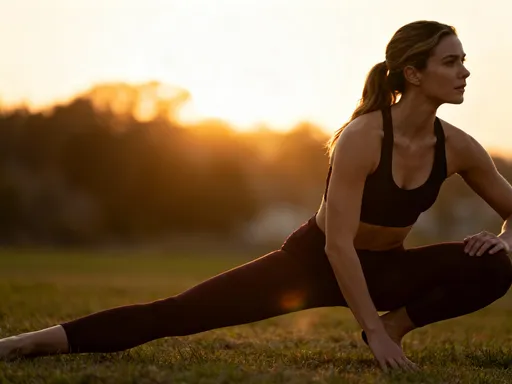
Hip openers, such as the seated figure-four stretch, address tightness in the glutes and piriformis — areas often neglected but critical for walking, sitting, and balance. By crossing one ankle over the opposite knee and leaning forward slightly, you create a deep, controlled stretch in the hip rotators. This is especially beneficial for those who sit for long periods, as prolonged sitting shortens hip flexors and weakens glutes. Shoulder rolls and arm circles complete the upper body component, releasing tension from desk work or daily stress. These movements improve shoulder range of motion and reduce strain on the neck and upper back.
Each stretch is most effective when paired with slow, diaphragmatic breathing. Inhaling prepares the body, while exhaling allows for a slight deepening of the stretch. This breath-movement connection calms the nervous system and enhances tissue relaxation. The entire routine takes just five minutes, requires no equipment, and can be done barefoot at home. It’s not about perfection — it’s about consistency. Over time, these small efforts compound, leading to noticeable improvements in posture, ease of movement, and overall comfort.
Timing, Triggers, and Habit Stacking
Motivation is fleeting, but habits endure. The secret to consistency is not willpower — it’s design. One of the most effective strategies for building a lasting flexibility habit is habit stacking, a concept popularized by behavioral scientists. This involves linking a new behavior to an existing one. For example, doing your 5-minute stretch immediately after brushing your teeth in the morning creates a natural cue. The act of brushing becomes the trigger, and stretching becomes the automatic follow-up. Over time, the brain associates the two, making the routine feel less like a chore and more like a natural part of the day.
Choosing the right time of day also matters. Many find morning stretching beneficial because it resets posture after hours of sleep and prepares the body for daily movement. Others prefer stretching after a warm shower, when muscles are naturally more pliable due to increased blood flow and heat. The key is to pick a time that aligns with your existing rhythm and stick to it. Environmental cues can further support consistency. Placing a yoga mat by the bed, setting a daily phone reminder, or keeping workout clothes visible can all serve as subtle prompts that reinforce the habit.
Tracking progress doesn’t require complex measurements. Simple, observable markers — such as how far you can reach toward your toes, how easily you get up from the floor, or how much less stiffness you feel in the morning — are powerful indicators of change. Keeping a brief journal or using a habit-tracking app can provide motivation and accountability. The goal is not perfection but continuity. Missing a day is not failure — it’s part of the process. What matters is returning to the routine without self-judgment. Over time, the habit becomes self-reinforcing: as flexibility improves, the body feels better, which naturally encourages continued practice.
Progress Without Pain — Listening to Your Body
Discomfort is a normal part of stretching — it signals that tissues are being gently challenged. Pain, however, is a warning sign. The difference lies in quality: discomfort feels like a deep, dull tension that eases with breath, while pain is sharp, localized, or radiating. Pushing into pain can lead to microtears in muscle or connective tissue, inflammation, or even long-term injury. The principle of progressive overload applies to flexibility just as it does to strength training — change happens through gradual, controlled stress, not force. The goal is to stretch to the edge of comfort, not beyond it.
Joint alignment is critical in preventing injury. For example, in a forward fold, rounding the back excessively can compress the spine, while locking the knees can strain the ligaments. Proper form — such as maintaining a slight bend in the knees and hinging from the hips — ensures that the stretch targets the intended muscles without compromising joint health. Similarly, in hip openers, keeping the spine tall and avoiding collapsing into the lower back protects the lumbar region. These alignment cues may seem minor, but they make a significant difference in safety and effectiveness.
Breathing is another essential tool for staying within safe limits. Holding your breath during a stretch increases intra-abdominal pressure and can trigger tension. In contrast, slow, rhythmic breathing activates the parasympathetic nervous system, promoting relaxation and deeper release. A simple technique is to inhale for four counts, then exhale for six, using the longer exhale to gently deepen the stretch. This not only prevents overstretching but also turns the routine into a mindfulness practice.
For individuals with hypermobility — naturally loose joints — the risk is different. They may be able to move into extreme ranges easily but lack the muscular control to stabilize those positions. In such cases, passive stretching can worsen joint instability. The focus should shift to active flexibility: using muscles to move into and hold positions. This builds strength within range of motion, creating balanced, functional flexibility. Everyone’s body is different, and listening to its signals is the most important skill in any flexibility journey.
Flexibility’s Hidden Benefits Beyond Movement
The benefits of regular stretching extend far beyond the ability to touch your toes or perform a deep lunge. Improved posture is one of the most visible changes. As tight muscles in the chest, hips, and spine release, the body naturally aligns into a more upright, balanced position. This reduces strain on the neck and lower back, decreasing the likelihood of chronic pain. Many people report fewer tension headaches and less lower back discomfort after just a few weeks of consistent stretching.
Sleep quality also improves. Muscle tension is closely linked to stress, and stretching helps break the cycle. When tight muscles are released, the body sends signals to the brain that it is safe to relax. This lowers cortisol levels, the primary stress hormone, and promotes the release of endorphins and serotonin — neurotransmitters associated with calm and well-being. A short stretching routine before bed can serve as a powerful wind-down ritual, signaling to the nervous system that it’s time to rest.
Circulation improves as well. Stretching increases blood flow to muscles and connective tissues, delivering oxygen and nutrients while removing metabolic waste. This supports recovery, reduces soreness, and enhances overall energy levels. Over time, better circulation contributes to healthier joints, as synovial fluid — the lubricant within joints — is distributed more effectively through movement.
Perhaps most importantly, flexibility supports healthy aging. As we grow older, connective tissues naturally lose elasticity, and joint range of motion decreases. This can lead to stiffness, reduced mobility, and a higher risk of falls. Regular stretching combats these changes, preserving independence and quality of life. Studies have shown that older adults who engage in flexibility training maintain better balance, coordination, and functional ability. Flexibility, in this sense, is not just about movement — it’s about maintaining freedom and dignity throughout life.
Making It Last — From Habit to Lifestyle
The final step in any transformation is integration. Flexibility should not be seen as a temporary goal but as a lifelong practice — a form of self-care as essential as eating well or sleeping enough. The mindset shift from “I have to stretch” to “I get to move my body” makes all the difference. When the routine becomes a gift rather than a task, it sustains itself. Celebrating small wins — like reaching the feet for the first time or noticing less stiffness after gardening — reinforces positive behavior and builds confidence.
Life changes, and so should your routine. There will be days when five minutes feels impossible, and that’s okay. The goal is not rigid adherence but flexible commitment. On busy days, do two minutes. When injured or fatigued, focus on gentle movement rather than deep stretches. The ability to adapt ensures longevity. Over time, the body begins to crave the release and clarity that stretching brings, making it easier to return even after a break.
Ultimately, real progress happens when routine becomes rhythm — when stretching is no longer something you do, but something you are. It becomes part of your identity: a person who moves with ease, who listens to their body, who values wellness. This is not about achieving a perfect pose or impressing others. It’s about feeling at home in your body, moving through life with less effort and more joy. Consistency, not intensity, is the quiet force behind lasting change. And with just five minutes a day, anyone can begin.